These are for you, TeamBruin!!!
Unreasonable Bill
A client, who felt his legal bill was too high, asked his lawyer to itemize costs.
The statement included this item:
"Was walking down the street and saw you on the other side. Walked to the corner to cross at the light, crossed the street and walked quickly to catch up with you. Got close and saw it wasn't you. -$50.00."
Need a new lawyer?
Warning Signs that you Might Need a Different Lawyer
1. Your lawyer tells you that his last good case was of Budweiser.
2. When the prosecutors see your lawyer, they high-five each other.
3. Your lawyer picks the jury by playing "duck-duck-goose."
4. Your lawyer tells you that he has never told a lie.
Wednesday, November 12, 2008
Thursday, November 06, 2008
CONQUEST OF EL CAPITAN
By Marek Warszawski / The Fresno Bee

Warren Harding, Wayne Merry and George Whitmore, left to right, wave their handkerchiefs in elation in 1958 after scaling what until then had been the unclimbed face of El Capitan. The picture was taken by Fresno Bee staff photographer Loyal Savaria within a few minutes after they walked up to the summit. About three hours before the climbers edged up over the rim of the sheer face, they ate breakfast before going on up to the top.
Much like it dominates the entrance to Yosemite Valley, El Capitan dominates Yosemite rock climbing. Climbers prefer the shortened version, El Cap, or its most common nickname, "The Captain." Three thousand feet of sheer, vertical granite that's as accessible as it is beautiful to look at.
While El Capitan has witnessed many astonishing climbs over the decades, none are more celebrated than the first ascent, a gargantuan effort finally completed in November 1958 by Warren Harding, Wayne Merry and George Whitmore.
The route that Harding, the party leader and one of Yosemite's legendary figures, had chosen and literally nailed his way up would become known as the Nose.
Fifty years later, the Nose remains the most popular route out of dozens on El Capitan. Each year hundreds of climbers, many of them from far-away countries, travel to Yosemite to tackle iconic features such as Stoveleg Crack, King Swing and the Great Roof.
"Every rock climber in the world knows the Nose of El Capitan," said Steve Roper, author of several books on the subject. "It's what they aspire to."
This weekend a large group of them, including some of the early pioneers, are commemorating the 50th anniversary of El Capitan's first ascent with two days of storytelling and slide-shows. Most events are open to the public.
Among the honorees are Fresno natives and lifelong residents Whitmore and Rich Calderwood, a team member who didn't reach the summit.
"We realized what we were doing was out of the ordinary and special, but it's safe to say we didn't realize how special it would be," said the 77-year old Whitmore, standing in the leafy front yard of his Fresno home. "To this day, my life is influenced by that climb."
Harding, who died in 2002, surely will be the gathering's biggest absence. Without this visionary, remembered both as "a brave and tenacious man" and "a sports car-driving, hard-living hedonist" by two who climbed with him, history wouldn't be the same.
When rock climbers first started poking around Yosemite Valley in the 1930s, El Capitan couldn't have been further from their minds. It was simply unfathomable. But standards (and boldness) improved rapidly, and by the mid-'50s every major formation had been scaled except El Capitan and Half Dome.
Half Dome, about two-thirds the height of El Capitan and less sheer, fell to a party led by Royal Robbins in June 1957. One prize remained, and Harding wanted it more than anything.
According to Roper's 1994 book, "Camp 4," Harding spent an entire day peering at El Capitan through binoculars trying to find a way up. El Cap has two major faces, southwest and southeast, and the route he chose followed the subtle prow on the buttress that connects them. This prow, or nose, is obvious only from the side.
"Warren always liked the boldest looking lines," said Ken Yager, president of the Yosemite Climbing Association. "But I think the main reason he chose it was it had an obvious ledge system that was nicely spaced out for storing provisions."
Harding and his rotating band of partners (eight men would pitch in at various intervals) needed plenty of provisions. While mountaineers in the Alps and Himalayas had climbed higher peaks under worse conditions, never before had anyone attempted a wall of this height and steepness.
A climb this huge required "siege tactics" that were unheard of in Yosemite. Instead of trying to complete the route in one continuous push, a notion that was deemed impossible, the climb was done incrementally. The party would spend all day reaching a certain high point, set fixed lines, rappel down and later use the fixed lines to regain their high point.
When Harding, Mark Powell and Bill "Dolt" Feuerer left the ground July 4, 1957, no one could have predicted it would take more than 16 months to reach the summit. Only 47 days were actually spent on the wall.
There are several reasons why the climb seemingly dragged on forever. For one, almost all the work got done on weekends because Harding and his crew either held regular jobs or were full-time students.
The climbing methods were radically different as well.
Unlike today's "free" climbers, who use rope and hardware only to protect themselves from falls, those in Harding's day practiced "aide" techniques. That is, they drove steel pitons into cracks in the wall and used them to gain elevation. To overcome blank walls where no cracks existed, they hammered expansion bolts.
"It's more like rock engineering than actual climbing," Roper said.
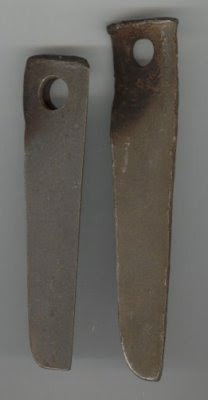
El Capitan also presented a unique set of challenges. To overcome a 300-foot series of 3-inch wide, nearly vertical slits in the rock, Harding utilized several custom wide-angle pitons that two friends, Frank Tarver and Calderwood, forged for him from the enameled legs of old-fashioned stoves.
The so-called stoveleg pitons have since entered into Yosemite legend.
Besides the 3,000-foot cliff itself, the other major obstacle was the Park Service. Tourists flocked to the base of El Capitan to watch the climbers progress, causing traffic jams on Yosemite's major artery. After a meeting with the chief ranger, Harding agreed to postpone the effort until after Labor Day.
By the end of November 1957, Harding and crew had climbed 1,200 feet to a sizable ledge named Dolt Tower. Winter arrived, and the fixed ropes were left dangling from the face till the following spring.
The climb resumed in March 1958, but progress was slow and deliberate. And for good reason: If anything went wrong up there, there was no hope of a rescue. After the Park Service imposed another summertime ban during the height of tourist season, rangers gave Harding a Thanksgiving deadline.
"I never understood how this was to be enforced," he later wrote.
By Nov. 1, 1958, fixed ropes reached to a ledge named Camp IV nearly 1,900 feet above terra firma. It was then that the group, which by this time consisted of Harding, Merry, Whitmore and Calderwood, decided to make a final push for the top.
"I remember Warren saying he was getting sick and tired of going up those goddamned ropes," said Whitmore, who joined up after spending two months climbing in Peru. "He said, 'Let's finish this climb, or let it finish us.' "
Harding decided to divide the duties. While he and Merry would be in the lead pushing the route, Whitmore and Calderwood were assigned the sherpa-like tasks of hauling loads and managing ropes.
To ascend fixed ropes in those days, climbers used a technique called prusiking that involved the use of three hitch knots, one affixed to a chest loop and the others to foot slings. Each knot could be slid up the fixed rope and tightened when body weight was applied, allowing for slow, incremental progress.
Making things more difficult, Whitmore and Calderwood had to prusik while toting 40-pound duffle bags that dangled below their feet from loops tied around their waists.
"It would take us half a day to reach the previous day's high point, by which time we'd be exhausted," Whitmore said.
Eight days in, Calderwood decided that he'd had enough and rappelled all the way to the ground without telling anyone he was quitting. Harding, Merry and Whitmore were left to wonder if he had fallen. (Earlier in the climb, an unroped Calderwood nearly plunged to his death from Dolt Tower.)
While Harding later wrote that Calderwood quit the climb because of "a bad case of nerves," the 71-year-old Calderwood offers a differing version, noting he was a Fresno State student with a pregnant wife who also worked full time at his dad's print shop.
"My father had instilled in me a puritan work ethic," he said. "I remember thinking, 'I've got to get back to work, I've got to get back to school and I don't have to do this.'"
The three-man team pushed on and by late afternoon Nov. 11, Harding and Merry stood on a tiny ledge only 120 feet below the top. At dusk, Whitmore joined them with a fresh supply of bolts, setting the stage for the most famous night in Yosemite climbing history.
Faced with a blank, overhanging wall above him, an exhausted Harding worked through the night, pounding 28 bolts into the rock before finally pulling himself onto the summit slabs shortly after dawn on Nov. 12, 1958.
"I didn't sleep much either," said Whitmore, who spent the night in slings impaled on a sharp point. "I remember hearing the 'tap, tap, tap' of Warren's hammer all night long."
News of the successful climb spread like wildfire thanks largely to Harding, who wasn't exactly averse to publicity (a trait that didn't endear him to other climbers of his era). Stories and photos of the first ascent team appeared in newspapers throughout the country.
Though he will always be remembered as the man who "conquered" El Capitan, Harding had a different take in his memoir, "Downward Bound."
"It was not at all clear to me who had conquered and who was conquered," he wrote in 1975. "I do recall that El Cap seemed to be in much better condition than I was."
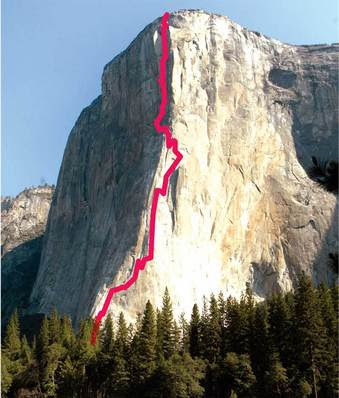
Of the dozens of routes rock climbers have used to scale the 3,000-foot sheer face of El Capitan, none are more famous (or more often repeated) than the Nose, indicated by the red line. Fifty years ago, Warren Harding, Wayne Merry and George Whitmore of Fresno pioneered this route during their historic first ascent in November 1958. The climb took 16 months, but only 47 days were spent on the wall.
FIRST ASCENT OF THE NOSE: 50TH ANNIVERSARY CELEBRATION
When: Saturday and Sunday
Where: Yosemite National Park
Schedule: Saturday, informal gathering at the East Auditorium (1-4 p.m.), slideshow (7:30 p.m.); Sunday, lunch at the Ahwahnee Hotel (noon)
Details: yosemiteclimbing.org
Notable Nose climbs
First ascent: November 1958 by Warren Harding, Wayne Merry and George Whitmore in 47 days over 16 months
Second ascent: September 1960 by Royal Robbins, Chuck Pratt, Tom Frost and Joe Fitschen in 71/2 days
First one-day ascent: June 1975 by Jim Bridwell, John Long and Billy Westbay in 17 hours, 40 minutes
First all-female ascent: 1977 by Molly Higgins and Barb Eastman
Youngest climber ascent: 1992 by 11-year-old Scott Cory
First free ascent: 1993 by Lynn Hill
Fastest ascent: Oct. 12, 2008 by Hans Florine and Yuji Hirayama in 2 hours, 37 minutes, 5 seconds
Warren Harding, Wayne Merry and George Whitmore, left to right, wave their handkerchiefs in elation in 1958 after scaling what until then had been the unclimbed face of El Capitan. The picture was taken by Fresno Bee staff photographer Loyal Savaria within a few minutes after they walked up to the summit. About three hours before the climbers edged up over the rim of the sheer face, they ate breakfast before going on up to the top.
Much like it dominates the entrance to Yosemite Valley, El Capitan dominates Yosemite rock climbing. Climbers prefer the shortened version, El Cap, or its most common nickname, "The Captain." Three thousand feet of sheer, vertical granite that's as accessible as it is beautiful to look at.
While El Capitan has witnessed many astonishing climbs over the decades, none are more celebrated than the first ascent, a gargantuan effort finally completed in November 1958 by Warren Harding, Wayne Merry and George Whitmore.
The route that Harding, the party leader and one of Yosemite's legendary figures, had chosen and literally nailed his way up would become known as the Nose.
Fifty years later, the Nose remains the most popular route out of dozens on El Capitan. Each year hundreds of climbers, many of them from far-away countries, travel to Yosemite to tackle iconic features such as Stoveleg Crack, King Swing and the Great Roof.
"Every rock climber in the world knows the Nose of El Capitan," said Steve Roper, author of several books on the subject. "It's what they aspire to."
This weekend a large group of them, including some of the early pioneers, are commemorating the 50th anniversary of El Capitan's first ascent with two days of storytelling and slide-shows. Most events are open to the public.
Among the honorees are Fresno natives and lifelong residents Whitmore and Rich Calderwood, a team member who didn't reach the summit.
"We realized what we were doing was out of the ordinary and special, but it's safe to say we didn't realize how special it would be," said the 77-year old Whitmore, standing in the leafy front yard of his Fresno home. "To this day, my life is influenced by that climb."
Harding, who died in 2002, surely will be the gathering's biggest absence. Without this visionary, remembered both as "a brave and tenacious man" and "a sports car-driving, hard-living hedonist" by two who climbed with him, history wouldn't be the same.
When rock climbers first started poking around Yosemite Valley in the 1930s, El Capitan couldn't have been further from their minds. It was simply unfathomable. But standards (and boldness) improved rapidly, and by the mid-'50s every major formation had been scaled except El Capitan and Half Dome.
Half Dome, about two-thirds the height of El Capitan and less sheer, fell to a party led by Royal Robbins in June 1957. One prize remained, and Harding wanted it more than anything.
According to Roper's 1994 book, "Camp 4," Harding spent an entire day peering at El Capitan through binoculars trying to find a way up. El Cap has two major faces, southwest and southeast, and the route he chose followed the subtle prow on the buttress that connects them. This prow, or nose, is obvious only from the side.
"Warren always liked the boldest looking lines," said Ken Yager, president of the Yosemite Climbing Association. "But I think the main reason he chose it was it had an obvious ledge system that was nicely spaced out for storing provisions."
Harding and his rotating band of partners (eight men would pitch in at various intervals) needed plenty of provisions. While mountaineers in the Alps and Himalayas had climbed higher peaks under worse conditions, never before had anyone attempted a wall of this height and steepness.
A climb this huge required "siege tactics" that were unheard of in Yosemite. Instead of trying to complete the route in one continuous push, a notion that was deemed impossible, the climb was done incrementally. The party would spend all day reaching a certain high point, set fixed lines, rappel down and later use the fixed lines to regain their high point.
When Harding, Mark Powell and Bill "Dolt" Feuerer left the ground July 4, 1957, no one could have predicted it would take more than 16 months to reach the summit. Only 47 days were actually spent on the wall.
There are several reasons why the climb seemingly dragged on forever. For one, almost all the work got done on weekends because Harding and his crew either held regular jobs or were full-time students.
The climbing methods were radically different as well.
Unlike today's "free" climbers, who use rope and hardware only to protect themselves from falls, those in Harding's day practiced "aide" techniques. That is, they drove steel pitons into cracks in the wall and used them to gain elevation. To overcome blank walls where no cracks existed, they hammered expansion bolts.
"It's more like rock engineering than actual climbing," Roper said.
El Capitan also presented a unique set of challenges. To overcome a 300-foot series of 3-inch wide, nearly vertical slits in the rock, Harding utilized several custom wide-angle pitons that two friends, Frank Tarver and Calderwood, forged for him from the enameled legs of old-fashioned stoves.
The so-called stoveleg pitons have since entered into Yosemite legend.

Besides the 3,000-foot cliff itself, the other major obstacle was the Park Service. Tourists flocked to the base of El Capitan to watch the climbers progress, causing traffic jams on Yosemite's major artery. After a meeting with the chief ranger, Harding agreed to postpone the effort until after Labor Day.
By the end of November 1957, Harding and crew had climbed 1,200 feet to a sizable ledge named Dolt Tower. Winter arrived, and the fixed ropes were left dangling from the face till the following spring.
The climb resumed in March 1958, but progress was slow and deliberate. And for good reason: If anything went wrong up there, there was no hope of a rescue. After the Park Service imposed another summertime ban during the height of tourist season, rangers gave Harding a Thanksgiving deadline.
"I never understood how this was to be enforced," he later wrote.
By Nov. 1, 1958, fixed ropes reached to a ledge named Camp IV nearly 1,900 feet above terra firma. It was then that the group, which by this time consisted of Harding, Merry, Whitmore and Calderwood, decided to make a final push for the top.
"I remember Warren saying he was getting sick and tired of going up those goddamned ropes," said Whitmore, who joined up after spending two months climbing in Peru. "He said, 'Let's finish this climb, or let it finish us.' "
Harding decided to divide the duties. While he and Merry would be in the lead pushing the route, Whitmore and Calderwood were assigned the sherpa-like tasks of hauling loads and managing ropes.
To ascend fixed ropes in those days, climbers used a technique called prusiking that involved the use of three hitch knots, one affixed to a chest loop and the others to foot slings. Each knot could be slid up the fixed rope and tightened when body weight was applied, allowing for slow, incremental progress.
Making things more difficult, Whitmore and Calderwood had to prusik while toting 40-pound duffle bags that dangled below their feet from loops tied around their waists.
"It would take us half a day to reach the previous day's high point, by which time we'd be exhausted," Whitmore said.
Eight days in, Calderwood decided that he'd had enough and rappelled all the way to the ground without telling anyone he was quitting. Harding, Merry and Whitmore were left to wonder if he had fallen. (Earlier in the climb, an unroped Calderwood nearly plunged to his death from Dolt Tower.)
While Harding later wrote that Calderwood quit the climb because of "a bad case of nerves," the 71-year-old Calderwood offers a differing version, noting he was a Fresno State student with a pregnant wife who also worked full time at his dad's print shop.
"My father had instilled in me a puritan work ethic," he said. "I remember thinking, 'I've got to get back to work, I've got to get back to school and I don't have to do this.'"
The three-man team pushed on and by late afternoon Nov. 11, Harding and Merry stood on a tiny ledge only 120 feet below the top. At dusk, Whitmore joined them with a fresh supply of bolts, setting the stage for the most famous night in Yosemite climbing history.
Faced with a blank, overhanging wall above him, an exhausted Harding worked through the night, pounding 28 bolts into the rock before finally pulling himself onto the summit slabs shortly after dawn on Nov. 12, 1958.
"I didn't sleep much either," said Whitmore, who spent the night in slings impaled on a sharp point. "I remember hearing the 'tap, tap, tap' of Warren's hammer all night long."
News of the successful climb spread like wildfire thanks largely to Harding, who wasn't exactly averse to publicity (a trait that didn't endear him to other climbers of his era). Stories and photos of the first ascent team appeared in newspapers throughout the country.
Though he will always be remembered as the man who "conquered" El Capitan, Harding had a different take in his memoir, "Downward Bound."
"It was not at all clear to me who had conquered and who was conquered," he wrote in 1975. "I do recall that El Cap seemed to be in much better condition than I was."
Of the dozens of routes rock climbers have used to scale the 3,000-foot sheer face of El Capitan, none are more famous (or more often repeated) than the Nose, indicated by the red line. Fifty years ago, Warren Harding, Wayne Merry and George Whitmore of Fresno pioneered this route during their historic first ascent in November 1958. The climb took 16 months, but only 47 days were spent on the wall.
FIRST ASCENT OF THE NOSE: 50TH ANNIVERSARY CELEBRATION
When: Saturday and Sunday
Where: Yosemite National Park
Schedule: Saturday, informal gathering at the East Auditorium (1-4 p.m.), slideshow (7:30 p.m.); Sunday, lunch at the Ahwahnee Hotel (noon)
Details: yosemiteclimbing.org
Notable Nose climbs
First ascent: November 1958 by Warren Harding, Wayne Merry and George Whitmore in 47 days over 16 months
Second ascent: September 1960 by Royal Robbins, Chuck Pratt, Tom Frost and Joe Fitschen in 71/2 days
First one-day ascent: June 1975 by Jim Bridwell, John Long and Billy Westbay in 17 hours, 40 minutes
First all-female ascent: 1977 by Molly Higgins and Barb Eastman
Youngest climber ascent: 1992 by 11-year-old Scott Cory
First free ascent: 1993 by Lynn Hill
Fastest ascent: Oct. 12, 2008 by Hans Florine and Yuji Hirayama in 2 hours, 37 minutes, 5 seconds


Wednesday, November 05, 2008
SHELTERS
The heavy equipment arrives today for the construction of two underground shelters. One at our place and another one at my brother-in-law's. There is a third shelter in the works near Oakhurst.
We are using old freight shipping containers. Some need reinforcing before they are covered with dirt.
The inventory (ever growing):
Rifles with scopes
Pistols
CCW permit
Ammunition
Bows
Crossbows
Arrows
Machetes
Knives
Axes
Shovels
Canned goods
Cooking oil
Seeds
Dehydrated foods
First aid kits
Compass
Rope
Clothing
Boots
Cold weather gear
Gas mask (two Israeli M-15)
Camping gear
Cots
Blankets
Pillows
Water filtration systems
Bleach
Engineer stakes
Barbed wire
Batteries
Fire starters
Firewood
Binoculars
Solar collectors
Generator
Sunday, November 02, 2008
NO DRIZZLE FIZZLE
El Nino, La Nina, La Nada...
Meteorologists can't bet one way or the other this year because there is no warm-water El Niño or cold-water La Niña in the Pacific Ocean. El Niño can mean more rain; La Niña can mean less.
This year, the ocean is La Nada -- the unofficial term that means the ocean's water temperature is normal, offering no clues for forecasters and little encouragement for farmers or reservoir operators.
There is one climate hint called the Madden/Julian Oscillation -- a powerful tropical wave of wind that circles the globe in 30 to 60 days. The wave is occurring right now and helped bring the first significant rain and snow to the state this weekend.
La Nada? The weekend storm dumped more than 1.5 inches at our basecamp at 1,500 feet.
Saturday was just a precursor of things to come. There were pockets of intermittent downpours all throughout the morning. As Pam and her mom were preparing dinner for my brother-in-law's 49th birthday, I was outside clearing out the lava rocks in preparation of making that part of the yard a Zen garden. The rain seemed to have stop. So much of the expectation of getting some desperately needed rain.
Late Saturday night there was steady activity of precipitation. Maybe, just maybe this is it...the first major storm to hit since the lightning strikes in June.
Sunday morning was a deluge. We were going to go running in the light rain, but just as we got dressed ready to run, the rain came down hard. Poor Sampson, who was outside under the back patio, was crying to be let in due to the noise of the rain coming down on the roof. He wasn't a very happy kitty.
Late Sunday afternoon, the sun broke through and off in the distance in the surrounding peaks near Bass Lake, the snow is visible.
The snowshoes are out.
Friday, October 31, 2008

Thursday, October 30, 2008
SNOW?
With a storm front moving into the San Joaquin Valley and the Sierra Nevada today and tonight, there is 50% chance of 3 to 5 feet of snow fallling in the high country above 10,000 feet with with winds between 15-25 mph with gusts up to 45 mph and ridge gusts topping out at 80 mph!!!
Hopefully, when the other "wetter" cold front moves through on Saturday, snow levels will dip to 7,000 feet!
Yeah, we will believe it when we see it from our vantage point.
Anyhow...
We got our snowshoes at the ready.
Hopefully, when the other "wetter" cold front moves through on Saturday, snow levels will dip to 7,000 feet!
Yeah, we will believe it when we see it from our vantage point.
Anyhow...
We got our snowshoes at the ready.
Monday, October 27, 2008
LAYERING
Layering your clothing is a tried-and-true way to ensure your comfort in the outdoors. The beauty of this simple concept is that it allows you to make quick adjustments based on your activity level and changes in the weather.
Each layer has a function: the innermost layer (against your skin) manages moisture; the middle layer insulates you from the cold; the outer layer shields you from wind and precipitation.
Your choices in an outer layer range from high-performance waterproof/breathable shell to a basic water-resistant wind jacket.
As a layering alternative, soft-shell outerwear, insulated shells and windproof fleece jackets offer characteristics of two or more layers in one garment.
Your Base Layer: Moisture Management
This is your next-to-skin layer. More than any other layer, the base layer helps regulate your body temperature. If you've ever worn a cotton T-shirt under your raincoat while you hiked, you probably remember feeling wet and clammy, even though you weren't getting wet from the rain itself.
Trapped inside your clothing, perspiration can leave you chilled or damp, no matter how well your outer shell fends off rain and snow. Cotton is an example of a fabric that retains perspiration and can leave you vulnerable to unwanted chills.
If you're active, your next-to-skin layer should be materials such as silk, wool or synthetic fabrics such as REI MTS®, Patagonia® Capilene®, Polartec® PowerDry® and CoolMax® polyester. Rather than absorbing moisture, these fabrics transport (or "wick") perspiration away from your skin, dispersing it on the outer surface, where it can evaporate. The result: You stay drier even when you sweat, and your shirt dries faster afterwards.
Examples: Keeping dry is important for maintaining a cool body temperature in the summer and avoiding hypothermia in the winter. Base layers can be anything from briefs and sports bras to long underwear sets (tops and bottoms) to tights and sport shirts. Thermal underwear is available in light-, mid- and expedition-weights. You can select the right weight to match your activity and the temperature.
Some base-layer garments are designed to fit snugly for better performance, range of motion and easier layering. For hot weather, the wicking layer often consists of a loose fitting, mesh garment.
Your Middle Layer: Insulation
The insulating layer helps you retain heat by trapping air close to your body. Polyester fleece vests, jackets and tights are classic examples of insulation ideal for outdoor activities. They not only trap air but are also made with moisture-wicking fibers to help keep you dry.
Natural fibers such as wool and goose down are excellent insulators. Wool sweaters and shirts (especially the new generation of merino wool products) offer soft, reliable warmth and keep on insulating even when wet. For very cold and dry conditions, goose down is still an excellent choice. It offers an unbeatable warmth-to-weight ratio and is highly compressible. Down's one drawback is that it must be kept dry to maintain its insulating ability.
Classic fleece such as Polartec® 100, 200 or Thermal Pro polyester and synthetic insulations such as Thinsulate® provides warmth for a variety of conditions. These are popular insulators because they're lightweight, breathable and insulate even when wet. They also dry faster and have a higher warmth-to-weight ratio than even wool. Classic fleece's main drawbacks are wind permeability and bulk (it's less compressible than other fabrics).
Like thermal underwear, fleece garments are available in 3 weights for different uses:
Lightweight for aerobic activity or mild climate
Midweight for moderate activity or climate
Expedition-weight for low activity or cold climate
Examples– For high-energy activities such as cross-country skiing, biking or running, choose lighter-weight fleece to avoid overheating. Tights or tops made of Polartec® 100 or Polartec PowerDry® are excellent for this. For very cold conditions, try thicker fleece such as Polartec® 200 or 300.
Wind fleece such as Polartec® Wind Pro polyester or Gore WindStopper® adds a high level of wind resistance to fleece. It accomplishes this via a hidden membrane that does not affect breathability or the other things we love most about fleece.
Your Shell Layer: Weather Protection
The shell (outer) layer protects you from wind, rain or snow. Shells range from pricey mountaineering jackets to simple windproof jackets, but most are designed to block precipation and hold in your body heat while allowing water vapor to escape. This is an important piece when you're active, because if wind and water are allowed to penetrate to your inner layers, you begin to cool off. Furthermore, without proper ventilation, perspiration can't evaporate but instead condenses on the inside of your shell.
Fit is another consideration. Your shell layer should be roomy enough to fit easily over other layers and not restrict your movement.
Shells can be lumped into the following categories:
Waterproof/Breathable Shells–These are usually the most functional (and more expensive) choices. They'll keep you comfortable in any weather, and are especially suited to wet, cold climates and alpine activities.
Fabrics (usually a laminated membrane or sometimes a fabric coating) include Gore-Tex®, REI Elements® and a wide variety of other branded choices. These shells are categorized by REI as rainwear, which emphasizes low weight and packability, or moutaineering wear, which is more abrasion-resistant and has additional features.
Water-Resistant/Breathable Shells–These are best for mild weather, light precipitation and high activity levels. They're usually made of tightly woven fabrics (such as mini ripstop nylon) that block the wind and treated with a Durable Water Repellent outer finish to make water bead and roll off.
Soft Shells–While many offer good wind and rain resistance, soft shells emphasize breathability. They are usually designed to offer both shell and insulative properties, so they in effect combine two layers into one.
Most feature stretch fabric or fabric panels for added comfort during aerobic activities. As this category has grown in popularity, styles have become specialized by season, so you'll now find cold- and mild-weather options.
Waterproof/Non-Breathable–Typically made of a durable, polyurethane-coated nylon, which is water- and windproof, these economical shells are ideal for rainy days with light activity.
Insulated Shells–Some outer shells have a layer of insulation built in, making them suitable for cold conditions, but not as versatile for layering in a variety of temperatures.
Monday, October 13, 2008
FIRST ANNIVERSARY
Our first anniversary in our home...
What a difference a year makes.
Pam and I are very happy to live...up here!!!
What a difference a year makes.
Pam and I are very happy to live...up here!!!
CLOSED FOR THE SEASON PART II
Now, Wawona Campground Loops B and C are closed for the season. Closing another chapter in the summer hiking season. Turn the page.
Pam and I camped at site 50 near the stream in our new REI Hobitat 6-person tent that we got on sale at REI Fresno on Tuesday! Nice! Roomy! You can stand up in it to put your clothes on and not have to do it sitting down.
 I know what you are thinking: "Just what is he doing?"


Friday night was our first night there. We get there around 3:00 p.m. to set up camp. The Hobitat is bulky and difficult to set up. It definitely takes 2 people to set up the tent.
Then the temperature mysteriously dropped 20 degrees. How do I know? My Kestrel 3000 Pocket Weather Monitor told me so. Then off in the distance you could see it coming...the snow. Not enough to stick to the ground, but enough to see it falling.
Yes, that is snow, but not a good picture of it.
Saturday, October 11, 2008
The thermometer reads 22°. Brrr.
Did I say, "BRRRRRRRRRR?"
Pam and I get up and start preparing breakfast. I go to the camp lavatory to get some water. Nothing. The pipes are frozen! Luckily, I had gotten some water the night before, but as soon as the water pours out of the spigot, it freezes.
We drive to the Wawona hotel and start hiking the Mariposa Grove Trail. The trailhead is behind the hotel. About a quarter mile into the hike we spot four grazing does to the left of us. They paid no attention to us. They kept grazing and kept getting closer and closer to us. If I were a hunter today...


Another 100 feet down the trail, I spot a small bobcat on the trail. I turned around and told Pam to come to where I was and have the camera ready. We approached very carefully. I passed by it first as it went off trail in search of food. Pam kept taking pictures as it did an about face and came between us only to proceed to the other side of the trail. Our only hope is that we did not deny its opporunity for a meal. Such an amazing animal. Had it been a mountain lion, then it would have been a completely different story.


We stopped hiking about 1.25 miles into the hike. Pam didn't have a good feeling about the hike and my back wasn't helping matters either. So we did an about face and headed back.
We go back, drop our packs off in the car, and wander through the hotel. Such a storied history. The menu selections were nice and reasonably priced. There were some organic entrees that caught Pam's eye. Yeah, yeah, yeah.
Later, we drove around the hotel area and ventured into the housing area near the hotel. Didn't know houses existed back there! I knew the rental cabins were back there, but I had no idea there were houses there, too...very nice houses to be exact. I can imagine waking up one morning after a good snow, sitting on the patio, drinking a cup of coffee, breathing in the pine-scented air and taking it all in. Then go back inside, sit beside the fireplace and falling into a trance as the warmth of the fire warms my body and thaws my soul.
Okay, back to reality...
We decide to drive to Glacier Point and investigate the rock slide damage from high up. We also wanted to see if we could get an trail condition reports from any hikers. We the turnoff and the sign says "Road Closed." Icy conditions and fallen trees on the road. Bummer. We head back.
As we headed back, we decided to take a little sidebar to Yosemite West to look at that residential area that some friends of our stay at whenever they are in the Yosemite are. Never been there. Geesh! What a place to call home for many people! No wonder we cannot convince our friends to stay with us! Fantabulous!
Before heading into camp, we stop at the Wawona store to restock on firewood and food.
We head back to camp. About 30 minutes later, you can see it coming again. Another dusting. Only this time it was held at bay about a half-mile from us. So much for another white camping day.
Sunday, October 12, 2008
As we awaken to the frigid cold in our tent, Pam and I decided we had enough. Let's go have breakfast in Oakhurst! So, we broke camp to head home. We stopped at the Wawona store to get that badly needed cup of coffee to wake up and to warm up to.
A thought did cross our minds to hike in Mariposa Grove, but we thought best we better take care of our hunger pangs first.
There will be other times.
Warmer times.
Strike that.
Snowier times.
Our snowshoes are ready.
Note: The Wawona gas station will be closed from around October 20 and not reopen to around November 20. The store and hotel will be open all year round.
Pam and I camped at site 50 near the stream in our new REI Hobitat 6-person tent that we got on sale at REI Fresno on Tuesday! Nice! Roomy! You can stand up in it to put your clothes on and not have to do it sitting down.
 I know what you are thinking: "Just what is he doing?"


Friday night was our first night there. We get there around 3:00 p.m. to set up camp. The Hobitat is bulky and difficult to set up. It definitely takes 2 people to set up the tent.
Then the temperature mysteriously dropped 20 degrees. How do I know? My Kestrel 3000 Pocket Weather Monitor told me so. Then off in the distance you could see it coming...the snow. Not enough to stick to the ground, but enough to see it falling.

Yes, that is snow, but not a good picture of it.
Saturday, October 11, 2008
The thermometer reads 22°. Brrr.
Did I say, "BRRRRRRRRRR?"
Pam and I get up and start preparing breakfast. I go to the camp lavatory to get some water. Nothing. The pipes are frozen! Luckily, I had gotten some water the night before, but as soon as the water pours out of the spigot, it freezes.
We drive to the Wawona hotel and start hiking the Mariposa Grove Trail. The trailhead is behind the hotel. About a quarter mile into the hike we spot four grazing does to the left of us. They paid no attention to us. They kept grazing and kept getting closer and closer to us. If I were a hunter today...


Another 100 feet down the trail, I spot a small bobcat on the trail. I turned around and told Pam to come to where I was and have the camera ready. We approached very carefully. I passed by it first as it went off trail in search of food. Pam kept taking pictures as it did an about face and came between us only to proceed to the other side of the trail. Our only hope is that we did not deny its opporunity for a meal. Such an amazing animal. Had it been a mountain lion, then it would have been a completely different story.


We stopped hiking about 1.25 miles into the hike. Pam didn't have a good feeling about the hike and my back wasn't helping matters either. So we did an about face and headed back.
We go back, drop our packs off in the car, and wander through the hotel. Such a storied history. The menu selections were nice and reasonably priced. There were some organic entrees that caught Pam's eye. Yeah, yeah, yeah.
Later, we drove around the hotel area and ventured into the housing area near the hotel. Didn't know houses existed back there! I knew the rental cabins were back there, but I had no idea there were houses there, too...very nice houses to be exact. I can imagine waking up one morning after a good snow, sitting on the patio, drinking a cup of coffee, breathing in the pine-scented air and taking it all in. Then go back inside, sit beside the fireplace and falling into a trance as the warmth of the fire warms my body and thaws my soul.
Okay, back to reality...
We decide to drive to Glacier Point and investigate the rock slide damage from high up. We also wanted to see if we could get an trail condition reports from any hikers. We the turnoff and the sign says "Road Closed." Icy conditions and fallen trees on the road. Bummer. We head back.
As we headed back, we decided to take a little sidebar to Yosemite West to look at that residential area that some friends of our stay at whenever they are in the Yosemite are. Never been there. Geesh! What a place to call home for many people! No wonder we cannot convince our friends to stay with us! Fantabulous!
Before heading into camp, we stop at the Wawona store to restock on firewood and food.
We head back to camp. About 30 minutes later, you can see it coming again. Another dusting. Only this time it was held at bay about a half-mile from us. So much for another white camping day.
Sunday, October 12, 2008
As we awaken to the frigid cold in our tent, Pam and I decided we had enough. Let's go have breakfast in Oakhurst! So, we broke camp to head home. We stopped at the Wawona store to get that badly needed cup of coffee to wake up and to warm up to.
A thought did cross our minds to hike in Mariposa Grove, but we thought best we better take care of our hunger pangs first.
There will be other times.
Warmer times.
Strike that.
Snowier times.
Our snowshoes are ready.
Note: The Wawona gas station will be closed from around October 20 and not reopen to around November 20. The store and hotel will be open all year round.
Thursday, September 25, 2008
CROWNED
My first major dental work in years finally came to a close.
I got my gold crown. All nice and shiny for now. My wife wanted me to go porcelain, but I liked gold and went for it.
I had a temporary since July 31. When I went in to get my gold on September 4, it wouldn't sit right on my tooth. According to the dentist and his staff, the lab blew it. I wanted an appointment on September 11, but that was too early so I had it rescheduled for September 25.
With the temporary, food kept getting jammed in between my teeth. Floss, floss, floss.
So finally after all these weeks.
"Don't eat sticky candy." Dang.
Wednesday, September 17, 2008
DR. MAO'S SECRETS OF LONGEVITY
The following was compliments of Yahoo!:
Diets are very hard, as is the feeling of being overweight. Many of these fad diets may promise instant and significant weight loss results, but most of them rely on depriving your body of certain nutrients and disrupting the natural function of your body's metabolism. Chinese medicine considers obesity to be partly the result of declining function of the metabolic fire of the kidney network and a diet that provides a well-balanced array of nutrients is the key to losing weight in a healthy way. What follows are five foods that will help you restore your body's ability to use energy and help you become your healthy weight.
1. Millet: A well-balanced diet should consist of whole grains instead of refined grains like white rice and pasta, and millet is a beneficial and delicious staple of this category of food. This non-glutinous grain is over 10-percent protein, has high amounts of fiber and B-complex vitamins, and because it isn't an acid forming food, is easy to digest.
2. Asparagus: When losing weight, it's important to favor chlorophyll-rich foods, including asparagus. Asparagus is a nutrient-rich vegetable packed with folate, vitamins A, C, and K, and fiber. Asparagus also contains a carbohydrate known as inulin (not to be confused with insulin) that promotes healthy bacteria in the large intestine - which in turn promotes a healthier digestive function.
3. Pomegranates: Eating a balanced diet to lose weight should include eating fresh fruits, and pomegranates are a wonderful example of a healthy, nutritious fruit that has antioxidant properties and will help prevent cancer. While the benefits of drinking pomegranate juice have gained a lot of attention recently, you will be more likely to lose weight by eating the fruit fresh to increase your fiber intake and keep the calories down.
4. Pine Nuts: Pine nuts are the edible seeds of pine trees and are considered an essential ingredient in the tasty Italian mixture pesto. Chinese medicine uses pine nuts to improve gastrointestinal tract and digestive functions, and pine nut oil is even used for appetite suppression. Pine nuts and other nuts are a tasty part of a well-balanced diet intended for weight loss.
5. Green Tea: It has been found that consuming large amounts of coffee and caffeine can lead to food cravings, increase one's appetite, and induce stress-related eating. Green tea is a wonderful alternative to coffee in that it does provide a little caffeine but also contains beneficial antioxidants. So drink up!
A healthy diet also includes lean proteins like chicken breast, legumes such as lentils, and other whole grains, fruits, and vegetables. While fad diets may promise a large amount of weight loss in a short period of time, there's almost a guarantee that you will put that weight back on-and then some!
Eat five smaller meals a day, avoid processed foods, chew more slowly, and incorporate more healthy foods into your diet-starting with these five.
I hope this article helps you find foods that can aid in your weight loss goals!
May you live long, live strong, and live happy!
-Dr. Mao
Sunday, September 14, 2008
WPNRT
After work, Pam and I drove to the holy city of Lone Pine in preparation for our "easy" 8-mile hike up and back the Whitney Portal National Recreational Trail from Lone Pine Campground. It was a four and one-half hour drive from Fresno, down to Bakerfield, to Highway 58 east to and passed Tehachapi, to Highway 14 and up the 395. We went this route to see how far and how long it would take us to get to Lone Pine once the Tioga Pass road is closed for the winter.
We had to do a Starbucks stop in Tulare. We both got black iced teas. Bakersfield was a mess being it was around 5:00 pm, but once we headed east on Highway 58 towards Tehachapi, it was smooth sailing.
We had to stop and make a "splash and dash" in the Hubcap Capital of the World...Pearsonville!
We stopped at one of the mini-marts just south of Lone Pine to stock up on last minute supplies. We had called in our dinner order at the Pizza Factory and had to make a stop there.
We arrive at our campsite and immediately set up camp in the dark. The lantern was our only source of light until Pam got the fire going.
We dined on lasagna, veggie spaghetti and antipasto salad and called it a night. Very calm. The flowing waters of Lone Pine Creek lulled us to sleep.
Saturday, September 13, 2008
We hit the trail at 8:51 am. The heat was pretty intense until we got passed the six switchbacks and headed for higher and shadier elevations. We spotted some mule deer (all bucks) about 3/4 of a mile into the hike. The only only wildlife we spotted was a Steller's Jay or two. Saw some bear scat on the trail but nothing else.


We reach Whitney Portal at 11:17 am. We stand on the rock where we exchanged wedding vows. We saunter over to the Portal Store to look around before ordering lunch. I ordered a Portal Burger and Fries while Pam ordered just the fries. Damn good!
We then headed back down the trail at 12:34 pm and reached the trailhead at Lone Pine Campground at 2:29. Again no encounters of any kind except for a few hikers here and there near the campgrounds. Pam and I never did encounter any hikers going up or coming down from Lone Pine Campground.
The hike according to my Garmin was about 8.08 miles and took us 4 hours and 21 minutes.
After cleaning up, we headed into town to get more supplies. Pam cooked up some organic vegetables and rice to go along with our salmon. Delicious. That night, the waxing gibbous moon was spectacular.
There were no bear sightings.


 The WPNRT provides some of the best framing shots for both amateur and professional photographers.
Sunday, September 14, 2008
We broke camp around 8:00 am and headed to town to have breakfast at the Mt. Whitney Restaurant.
We drove up to Bishop to get a cup of coffee at the Looney Bin. We did not stop at Schat's Bakkery.
We turned off onto Tioga Pass road and stopped at the bridger over the Tuolumne River to soak our feet. The river is considerably low this time of year.
We stopped off at Olmsted Point to take in some of the grand vistas of Half Dome, Clouds Rest and Tenaya Canyon.


 Many of the erratics left by glaciers long ago.


 Erratics.


 Tenaya Lake way in the back.
 Looking towards Tenaya Lake.
 If Half Dome could only be THIS easy.
 Half Dome and Quarter Dome. If one won't get you, the other one DEFINITELY will!

If you are planning a trip to Tuolumne Meadows, there is no gas service. The gas station is having its leaking underground storage tanks being replaced.
 Wherever I may roam...
Thursday, September 11, 2008
FIRE

 A structural fire broke out just less than 1/4 mile from our house around 5:15 p.m.
Pam and I got home around 5:00. I went out into our backyard and smelled smoke. I surmised it was the Tehipite fire that was still burning miles away near Kings Canyon.
I came back inside the house and Pam is walking towards me in the hallway to the den and said she smelled smoke as if it were in the house. I told her it is smoky outside.
I went to the garage to start loading gear for our upcoming camping trip in the Sierra Nevada. As I come out of the garage through the garage door I glance to my right and couldn't help but notice this tall column of black smoke from the west coming from the other side of the next crest.
I went back in the house and dialed 911 as I walked out towards the street. The dispatch said fire crews were on the way to the fire on Road 400.
"Road 400? Ma'am, the fire is burning in Yosemite Lakes Park and I am located about 1/4 mile from the fire!"
She said nothing more. I left it at that.
Within 10 minutes of making that 911 call that fire became a grass fire. Where are the fire crews?

 I hear sirens but they are down in the valley. They are going the wrong way! They are going down Road 400.
I see the Fire Chief vehicle off in the distance on the next crest.
In the meantime, our street has become a parking lot with onlookers.
I walk down to our neighbor's house down in the draw. I ring the doorbell. No one is home. They have horses. They are calm, but for how long? As I was making my way back up their driveway, my neighbor comes flying down the driveway. I give him the situation and if there was anything we could do, we would be willing to assist.
Soon, there was an OV-10A Airtactical spotter plane circling overhead.

Two other aircraft soon arrived. An S-2A Airtanker swoops in and delivers its 800 gallon load of fire retardant. It is amazing how they can drop this right on target. Another tanker, an S2-T Airtanker delivers its 1200 gallons of fire retardant with a direct hit. Both planes make two drops each.
We could hear the bulldozer that was called in to establish a fire break. We did not see it, but you could sure hear it.
Two helicopters arrive on scene to extinguish what little fire was left. One I couldn't recognize, but the other one had this very distinct "wump-wump-wump" sound. Gotta be a Huey. And it was. A UH-1H Huey. The little chopper that could. It appeared to us that everytime that Huey filled up the bucket with water a majority of the water spilled out. You could see it draining from the bucket in flight. I was reminded of cartoon characters running with a bucket of water only to have a drop left to douse the fire.
After the helicopters left the ground crew moved in with their chainsaws.
Around 9:00 p.m. the embers were still glowing. Our neighbors down below were still outside watching and listening to all that was going on.
Thanks to the efforts of the CDF fire crews the fire was contained and no other structures were damaged. For a moment there, when the wind-fanned inferno flared up, we thought other the houses in the vicinity were going to be destroyed. We had concerns ours would be, too.
It was quite the airshow. Pam and I were amazed at the precision and coordination demonstrated by the fire crews.

 Fire retardant being dropped.
 One of the helicopters


Monday, September 08, 2008
CYCLE OF LIFE
Delilah, one of the kittens that entered our lives back in May, is gone. The victim of a possible coyote or owl attack on Friday, August 29.
Just that morning, Samson and Delilah accompanied me to get the newspaper. They always scampered about and then dig their claws into the railroad ties that line our driveway and go off into the hillside.
I was in the kitchen reading the paper when I heard a cat scream. I knew something was very wrong. I went outside to look for the cats. I did not see them. I searched all around the house. Nothing
I said nothing to my wife about what I had heard in the kitchen during our commute to work.
All during the day my mind couldn't help but wonder if both cats were okay. Earlier in the week, my in-laws had both cats fixed.
Pam and I got home after work and my mother-in-law mentioned she had not seen Delilah all day. She saw Samson, but not Delilah. I told my mother-in-law what I had heard earlier in the day.
With rattlesnakes, bobcats, coyotes, and scorpions all around us there is no guarantee to the safety of pets. It is a part of life up here.
We will miss Delilah. A very playful and curious kitten. Always getting into things. Always playing with Samson.
Thursday, September 4, when I went to go get the morning paper, Samson was not at his favorite sleeping spot on the padded chair. He was nowhere to be found. This time I told Pam.
Again, we get home, and I do not see him. Then out of nowhere there he was. He plops down at my feet as if to say, "Here I am." I pick him up and take him to the kitchen window to show Pam. A look of relief overtook Pam's face, and Mom looked at me as if to say, "Yeah? So?" Mom tells me that she had been playing with Sampson earlier in the day.
Samson still stays outside. He still accompanies me to get the morning paper. He is a lot more outgoing just like his sister. Plays with his catnip toy. Still banging his head on the table. Wild and riled Samson is.
Sunday, August 24, 2008
ECKHART TOLLE
During our trip to Lassen, Shasta, Crater Lake, Redwoods, and San Francisco, Pam and I listened to the eight CD audio of Eckhart Tolle's book, "A New Earth--Awakening to Your Life's Purpose."
Pam's brother had the book and the CDs and allowed us to listen to them on our trip. My brother-in-law going Jesus and Zen on us? Not actually, but he has been talking about this book and CD for some time. I just never paid attention.
At first I was very, very, very skeptical when Pam inserted the first disc in the CD player as we headed up Interstate 5 just north of Redding. I thought to myself, now here is another guy preaching his way to the Holy Land. Blah, blah, blah. Yes, I am spiritual, but not religious.
I blocked out all preconceived notions and negative thoughts and concentrated on driving while Pam and I listened to this CD.
I was moved by what I listened to.
Here is an excerpt from that book...
Chapter 1: The Flowering of Human Consciousness
EVOCATION
Earth, 114 million years ago, one morning just after sunrise: The first flower ever to appear on the planet opens up to receive the rays of the sun. Prior to this momentous event that heralds an evolutionary transformation in the life of plants, the planet had already been covered in vegetation for millions of years. The first flower probably did not survive for long, and flowers must have remained rare and isolated phenomena, since conditions were most likely not yet favorable for a widespread flowering to occur. One day, however, a critical threshold was reached, and suddenly there would have been an explosion of color and scent all over the planet—if a perceiving consciousness had been there to witness it.
Much later, those delicate and fragrant beings we call flowers would come to play an essential part in the evolution of consciousness of another species. Humans would increasingly be drawn to and fascinated by them. As the consciousness of human beings developed, flowers were most likely the first thing they came to value that had no utilitarian purpose for them, that is to say, was not linked in some way to survival. They provided inspiration to countless artists, poets, and mystics. Jesus tells us to contemplate the flowers and learn from them how to live. The Buddha is said to have given a “silent sermon” once during which he held up a flower and gazed at it. After a while, one of those present, a monk called Mahakasyapa, began to smile.
He is said to have been the only one who had understood the sermon. According to legend, that smile (that is to say, realization) was handed down by twenty-eight successive masters and much later became the origin of Zen.
Seeing beauty in a flower could awaken humans, however briefly, to the beauty that is an essential part of their own innermost being, their true nature. The first recognition of beauty was one of the most significant events in the evolution of human consciousness. The feelings of joy and love are intrinsically connected to that recognition. Without our fully realizing it, flowers would become for us an expression in form of that which is most high, most sacred, and ultimately formless within ourselves. Flowers, more fleeting, more ethereal, and more delicate than the plants out of which they emerged, would become like messengers from another realm, like a bridge between the world of physical forms and the formless. They not only had a scent that was delicate and pleasing to humans, but also brought a fragrance from the realm of spirit. Using the word “enlightenment” in a wider sense than the conventionally accepted one, we could look upon flowers as the enlightenment of plants.
Any life-form in any realm—mineral, vegetable, animal, or human—can be said to undergo “enlightenment.” It is, however, an extremely rare occurrence since it is more than an evolutionary progression: It also implies a discontinuity in its development, a leap to an entirely different level of Being and, most important, a lessening of materiality.
What could be heavier and more impenetrable than a rock, the densest of all forms? And yet some rocks undergo a change in their molecular structure, turn into crystals, and so become transparent to the light. Some carbons, under inconceivable heat and pressure, turn into diamonds, and some heavy minerals into other precious stones.
Most crawling reptilians, the most earthbound of all creatures, have remained unchanged for millions of years.
Some, however, grew feathers and wings and turned into birds, thus defying the force of gravity that had held them for so long. They didn’t become better at crawling or walking, but transcended crawling and walking entirely.
Since time immemorial, flowers, crystals, precious stones, and birds have held special significance for the human spirit. Like all life-forms, they are, of course, temporary manifestations of the underlying one Life, one Consciousness.
Their special significance and the reason why humans feel such fascination for and affinity with them can be attributed to their ethereal quality.
Once there is a certain degree of Presence, of still and alert attention in human beings’ perceptions, they can sense the divine life essence, the one indwelling consciousness or spirit in every creature, every life-form, recognize it as one with their own essence and so love it as themselves. Until this happens, however, most humans see only the outer forms, unaware of the inner essence, just as they are unaware of their own essence and identify only with their own physical and psychological form.
In the case of a flower, a crystal, precious stone, or bird, however, even someone with little or no Presence can occasionally sense that there is more there than the mere physical existence of that form, without knowing that this is the reason why he or she is drawn toward it, feels an affinity with it. Because of its ethereal nature, its form obscures the indwelling spirit to a lesser degree than is the case with other life-forms. The exception to this are all newborn life-forms—babies, puppies, kittens, lambs, and so on. They are fragile, delicate, not yet firmly established in materiality. An innocence, a sweetness and beauty that are not of this world still shine through them. They delight even relatively insensitive humans.
So when you are alert and contemplate a flower, crystal, or bird without naming it mentally, it becomes a window for you into the formless. There is an inner opening, however slight, into the realm of spirit. This is why these three “en-lightened” life-forms have played such an important part in the evolution of human consciousness since ancient times; why, for example, the jewel in the lotus flower is a central symbol of Buddhism and a white bird, the dove, signifies the Holy Spirit in Christianity. They have been preparing the ground for a more profound shift in planetary consciousness that is destined to take place in the human species. This is the spiritual awakening that we are beginning to witness now.
THE PURPOSE OF THIS BOOK
Is humanity ready for a transformation of consciousness, an inner flowering so radical and profound that compared to it the flowering of plants, no matter how beautiful, is only a pale reflection? Can human beings lose the density of their conditioned mind structures and become like crystals or precious stones, so to speak, transparent to the light of consciousness? Can they defy the gravitational pull of materialism and materiality and rise above identification with form that keeps the ego in place and condemns them to imprisonment within their own personality? The possibility of such a transformation has been the central message of the great wisdom teachings of humankind.
The messengers—Buddha, Jesus, and others, not all of them known—were humanity’s early flowers. They were precursors, rare and precious beings. A widespread flowering was not yet possible at that time, and their message became largely misunderstood and often greatly distorted.
It certainly did not transform human behavior, except in a small minority of people.
Is humanity more ready now than at the time of those early teachers? Why should this be so? What can you do, if anything, to bring about or accelerate this inner shift? What is it that characterizes the old egoic state of consciousness, and by what signs is the new emerging consciousness recognized?
These and other essential questions will be addressed in this book. More important, this book itself is a transformational device that has come out of the arising new consciousness. The ideas and concepts presented here may be important, but they are secondary. They are no more than signposts pointing toward awakening. As you read, a shift takes place within you.
This book’s main purpose is not to add new information or beliefs to your mind or to try to convince you of anything, but to bring about a shift in consciousness, that is to say, to awaken. In that sense, this book is not “interesting.”
Interesting means you can keep your distance, play around with ideas and concepts in your mind, agree or disagree.
This book is about you. It will change your state of consciousness or it will be meaningless. It can only awaken those who are ready. Not everyone is ready yet, but many are, and with each person who awakens, the momentum in the collective consciousness grows, and it becomes easier for others. If you don’t know what awakening means, read on. Only by awakening can you know the true meaning of that word. A glimpse is enough to initiate the awakening process, which is irreversible. For some, that glimpse will come while reading this book. For many others who may not even have realized it, the process has already begun.
This book will help them recognize it. For some, it may have begun through loss or suffering; for others, through coming into contact with a spiritual teacher or teaching, through reading The Power of Now or some other spiritually alive and therefore transformational book—or any combination of the above. If the awakening process has begun in you, the reading of this book will accelerate and intensify it.
An essential part of the awakening is the recognition of the unawakened you, the ego as it thinks, speaks, and acts, as well as the recognition of the collectively conditioned mental processes that perpetuate the unawakened state.
That is why this book shows the main aspects of the ego and how they operate in the individual as well as in the collective.
This is important for two related reasons: The first is that unless you know the basic mechanics behind the workings of the ego, you won’t recognize it, and it will trick you into identifying with it again and again. This means it takes you over, an imposter pretending to be you.
The second reason is that the act of recognition itself is one of the ways in which awakening happens. When you recognize the unconsciousness in you, that which makes the recognition possible is the arising consciousness, is awakening.
You cannot fight against the ego and win, just as you cannot fight against darkness. The light of consciousness is all that is necessary. You are that light.
Captivating. And this was just the first CD.
Friday, August 22, 2008
THE "AWAKENING" TRIP
Pam and I took advantage of our time to take our last major vacation of the year.
The record setting heat in Redding (109°), seeing the majestic Lassen Peak for the first time, hiking the infamous Bumpass Hell trail, seeing Mt. Shasta without the snow, Crater Lake, the roaring Rogue River, the record setting heat in Medford, OR (108°), the seaside resort of Crescent City, camping at Mill Creek Campground, hiking Damnation Trail, staying and driving through Santa Cruz, taking a "spur" to Big Sur and then back up and over to Gilroy.
BUMPASS HELL TRAIL (08/14/08)
We pulled into the holy city of Redding to check into our hotel, dump our gear and then head out on SR 44 to drive 44 miles to Lassen Volcanic Park. HOT! HOT! HOT! Our drive to Lassen was scenic. We drove around clockwise around the park. There was some road construction going on causing delays on our way around the park.
 Bumpass Hell trail. A short hike of a little over 3 miles. A very easy hike. Just bring a bottle of water.
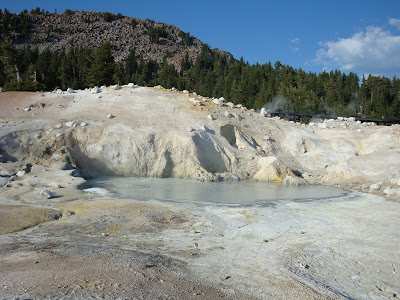 Lassen Volcanic National Park's version of Yellowstone.
 The Dead Pool. This is an "extinct" hot spring.
 Lassen Peak. The hike to the summit from the trailhead is only 2 miles one way. Maybe some day, Pam and I will stand on its summit.
MT. SHASTA (08/15/08)
 Mt. Shasta on the right. We drove around the Mt. Shasta area looking for ideal places to camp. Couldn't find any, because many were full or were not ideal enough. So we drove out on SR 89 and not much luck there either. After stopping in town to get a cup of coffe, we decided it was best to go to Crater Lake as a consolation and make it a highlight for Pam's special day.
 Weed, CA. I couldn't resist stopping at the Weed offramp to get a photo of the city limit sign of the holy city of Weed. What a name for a town.
CRATER LAKE (08/15/08)
 Crater Lake. We get there around mid-afternoon. We took I-5 north just short of Ashland and headed east on Highway 66 to Klamath Falls and Klamath Lake and then took Highway 62 into the Crater Lake. After stopping at the gift shop, we drove around the lake, stopping here and there to take a few pictures and gaze at this natural wonder.
 Wizard Island.
 Two beautiful sights to behold!
 Valley shot from the Crater Lake drive. I wonder what peak that is?
 Phantom Ship.
After Crater Lake, we stopped to see the lava tubes on the Rogue River and then it was Medford. We drove around the town looking for good places to stay and wound up staying at the Rogue River Inn. The city planners and the civil engineers must have been at odds with each other, because it was like driving in a maze from the highway to the hotel. The next morning, I'll be damned that every turn I took to exit the parking lot was a dead end. I eventually followed a garbage truck to get the heck out of there. We headed up north to Grants Pass and took Highway 199 and headed west and south to California and the holy city of Crescent City.
MILL CREEK CAMPGROUND (08/16/08-08/17/08)
 Campsite #101 at Mill Creek south of Crescent City, CA. Our camp was completely inside a fire-gutted redwood.
DAMNATION TRAIL (08/16/07)
 The redwoods along Damnation Trail took your mind off the descent. If only BFI and Poles at Crystal Cove State Park were this beautiful.
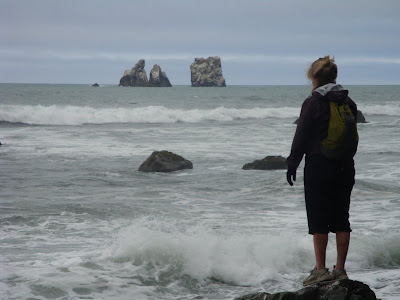 The end of the descent of Damnation Trail.
 Driftwood wedged between the rocks.
 The spectacular ocean views at the end of Damnation Trail.
 The window. Don't know what kind of bones those are in the lower right of the picture.
 Pam, the Treehugger.
 Strenuous trail? Really? Yes, it was! Well, actually not that bad. The giant redwoods took our minds off the hike as we took in our surroundings.
Our final night at the camp was eventful. We heard what sounded like a bird but it could have been a raptor from Jurassic Park. Eerie sound. Elk maybe? But we didn't hear any other noise but for the strange sound. We don't know what it was that made that strange noise. Then the rains came and the thunder.
That morning, it was still sprinkling. We canceled our breakfast. Was looking forward to the bacon, eggs, and, of course, rice! We broke camp and headed south.
THE COAST (08/18/08)
 Please, no tsunami now. We see numerous signs like these on our way to Eureka. In some areas, you can see new growth of trees: Evidence of a tsunami many years ago.
We made our way down the coast and stopped in San Rafael to stay for the night before deciding to head into San Francisco for the next two days.
SAN FRANCISCO (08/19/08)
We checked into another hotel near Fisherman's Wharf and unloaded our stuff before walking down to the Wharf. Pam wanted to stop by the Patagonia store just to say she was there. The store is a converted garage with all the latest gear from Patagonia. I resisted the tempation to purchase a down sweater that was so lightweight and less bulky than a regular down jacket. But at $200, I will wait until a sale.
 The food and service at Bubba Gump's for lunch was superb.
We decided to take a cable car to downtown Frisco. I had never ridden in a cable car and I had no idea it costs $5.00 ONE WAY to ride. I thought you see the cable car, hop on and get off wherever and whenever you wanted to. We get to downtown and we start walking around and Pam gets a little anxious with all the drifters and peddlers about. It was getting close to sundown so it was best we head back to the Wharf. The line for the cable car was too long so we decided to hoof it up the steep hills of Frisco. We boarded the cable car for a little ways and got off and finished our "hike" down to the pier. We went to Ghirardelli's for some free chocolate and indulged ourselves in some ice cream.
SAN FRANCISCO PART II (08/21/08)
We drove to San Francisco Park via Haight/Ashbury.
 What a name for an eatery in San Francisco. We ate at a cafe directly across the street since it had more of an organic menu selection.
 How about Luv and Haight? What is so mystical about this place. We stopped in a shop to pass the time. Bought some stuff (nope no drug paraphernalia) and walked down a couple of blocks along Haight.
 That "flower" place in Golden Gate Park. Pam and I had never been there. Of course, I would never have gone had it not been for Pam. The orchids were a sight to behold. Orchid pictures? Maybe I will post at a later time.
 Japanese Tea Garden. Structures such as these were erected to represent huge guardians.
 This is a better angle of what I was talking about. If you let your eyes get blurry you will be able to make out the helmet, eyes, and mouth.
SANTA CRUZ (08/21/08)
After leaving Frisco, we headed down south to Santa Cruz via Half Moon Bay and the coast. We stayed at one of the hotels along Highway 1.
 Santa Cruz. Pam saw this sign and saw a connection to the CD we were listening to during our trip. The Food Bin was loaded with all kinds of organic foods. The Herb Room had all kinds of organic and herbal remedies.
 The other side of the sign.
HOMEWARD BOUND (08/22/08)
We left Santa Cruz to head down to Big Sur before heading back north the way we came. We reached Watsonville and headed east towards Gilroy. We were trying to find a vegetable stand to get some of that infamous Gilroy garlic. All hopes faded until we were east of town and found a stand that had braided garlic bundle.
 Wherever I may roam...
The record setting heat in Redding (109°), seeing the majestic Lassen Peak for the first time, hiking the infamous Bumpass Hell trail, seeing Mt. Shasta without the snow, Crater Lake, the roaring Rogue River, the record setting heat in Medford, OR (108°), the seaside resort of Crescent City, camping at Mill Creek Campground, hiking Damnation Trail, staying and driving through Santa Cruz, taking a "spur" to Big Sur and then back up and over to Gilroy.
BUMPASS HELL TRAIL (08/14/08)
We pulled into the holy city of Redding to check into our hotel, dump our gear and then head out on SR 44 to drive 44 miles to Lassen Volcanic Park. HOT! HOT! HOT! Our drive to Lassen was scenic. We drove around clockwise around the park. There was some road construction going on causing delays on our way around the park.
 Bumpass Hell trail. A short hike of a little over 3 miles. A very easy hike. Just bring a bottle of water.
 Lassen Volcanic National Park's version of Yellowstone.
 The Dead Pool. This is an "extinct" hot spring.
 Lassen Peak. The hike to the summit from the trailhead is only 2 miles one way. Maybe some day, Pam and I will stand on its summit.
MT. SHASTA (08/15/08)
 Mt. Shasta on the right. We drove around the Mt. Shasta area looking for ideal places to camp. Couldn't find any, because many were full or were not ideal enough. So we drove out on SR 89 and not much luck there either. After stopping in town to get a cup of coffe, we decided it was best to go to Crater Lake as a consolation and make it a highlight for Pam's special day.
 Weed, CA. I couldn't resist stopping at the Weed offramp to get a photo of the city limit sign of the holy city of Weed. What a name for a town.
CRATER LAKE (08/15/08)
 Crater Lake. We get there around mid-afternoon. We took I-5 north just short of Ashland and headed east on Highway 66 to Klamath Falls and Klamath Lake and then took Highway 62 into the Crater Lake. After stopping at the gift shop, we drove around the lake, stopping here and there to take a few pictures and gaze at this natural wonder.
 Wizard Island.
 Two beautiful sights to behold!
 Valley shot from the Crater Lake drive. I wonder what peak that is?
 Phantom Ship.
After Crater Lake, we stopped to see the lava tubes on the Rogue River and then it was Medford. We drove around the town looking for good places to stay and wound up staying at the Rogue River Inn. The city planners and the civil engineers must have been at odds with each other, because it was like driving in a maze from the highway to the hotel. The next morning, I'll be damned that every turn I took to exit the parking lot was a dead end. I eventually followed a garbage truck to get the heck out of there. We headed up north to Grants Pass and took Highway 199 and headed west and south to California and the holy city of Crescent City.
MILL CREEK CAMPGROUND (08/16/08-08/17/08)
 Campsite #101 at Mill Creek south of Crescent City, CA. Our camp was completely inside a fire-gutted redwood.
DAMNATION TRAIL (08/16/07)
 The redwoods along Damnation Trail took your mind off the descent. If only BFI and Poles at Crystal Cove State Park were this beautiful.
 The end of the descent of Damnation Trail.
 Driftwood wedged between the rocks.
 The spectacular ocean views at the end of Damnation Trail.
 The window. Don't know what kind of bones those are in the lower right of the picture.
 Pam, the Treehugger.
 Strenuous trail? Really? Yes, it was! Well, actually not that bad. The giant redwoods took our minds off the hike as we took in our surroundings.
Our final night at the camp was eventful. We heard what sounded like a bird but it could have been a raptor from Jurassic Park. Eerie sound. Elk maybe? But we didn't hear any other noise but for the strange sound. We don't know what it was that made that strange noise. Then the rains came and the thunder.
That morning, it was still sprinkling. We canceled our breakfast. Was looking forward to the bacon, eggs, and, of course, rice! We broke camp and headed south.
THE COAST (08/18/08)
 Please, no tsunami now. We see numerous signs like these on our way to Eureka. In some areas, you can see new growth of trees: Evidence of a tsunami many years ago.
We made our way down the coast and stopped in San Rafael to stay for the night before deciding to head into San Francisco for the next two days.
SAN FRANCISCO (08/19/08)
We checked into another hotel near Fisherman's Wharf and unloaded our stuff before walking down to the Wharf. Pam wanted to stop by the Patagonia store just to say she was there. The store is a converted garage with all the latest gear from Patagonia. I resisted the tempation to purchase a down sweater that was so lightweight and less bulky than a regular down jacket. But at $200, I will wait until a sale.
 The food and service at Bubba Gump's for lunch was superb.
We decided to take a cable car to downtown Frisco. I had never ridden in a cable car and I had no idea it costs $5.00 ONE WAY to ride. I thought you see the cable car, hop on and get off wherever and whenever you wanted to. We get to downtown and we start walking around and Pam gets a little anxious with all the drifters and peddlers about. It was getting close to sundown so it was best we head back to the Wharf. The line for the cable car was too long so we decided to hoof it up the steep hills of Frisco. We boarded the cable car for a little ways and got off and finished our "hike" down to the pier. We went to Ghirardelli's for some free chocolate and indulged ourselves in some ice cream.
SAN FRANCISCO PART II (08/21/08)
We drove to San Francisco Park via Haight/Ashbury.
 What a name for an eatery in San Francisco. We ate at a cafe directly across the street since it had more of an organic menu selection.
 How about Luv and Haight? What is so mystical about this place. We stopped in a shop to pass the time. Bought some stuff (nope no drug paraphernalia) and walked down a couple of blocks along Haight.
 That "flower" place in Golden Gate Park. Pam and I had never been there. Of course, I would never have gone had it not been for Pam. The orchids were a sight to behold. Orchid pictures? Maybe I will post at a later time.
 Japanese Tea Garden. Structures such as these were erected to represent huge guardians.
 This is a better angle of what I was talking about. If you let your eyes get blurry you will be able to make out the helmet, eyes, and mouth.
SANTA CRUZ (08/21/08)
After leaving Frisco, we headed down south to Santa Cruz via Half Moon Bay and the coast. We stayed at one of the hotels along Highway 1.
 Santa Cruz. Pam saw this sign and saw a connection to the CD we were listening to during our trip. The Food Bin was loaded with all kinds of organic foods. The Herb Room had all kinds of organic and herbal remedies.
 The other side of the sign.
HOMEWARD BOUND (08/22/08)
We left Santa Cruz to head down to Big Sur before heading back north the way we came. We reached Watsonville and headed east towards Gilroy. We were trying to find a vegetable stand to get some of that infamous Gilroy garlic. All hopes faded until we were east of town and found a stand that had braided garlic bundle.
 Wherever I may roam...
Subscribe to:
Posts (Atom)